1Singapore University of Technology and Design 2Institute for Infocomm Research, A*STAR, Singapore
*Corresponding authors
ECCV 2026
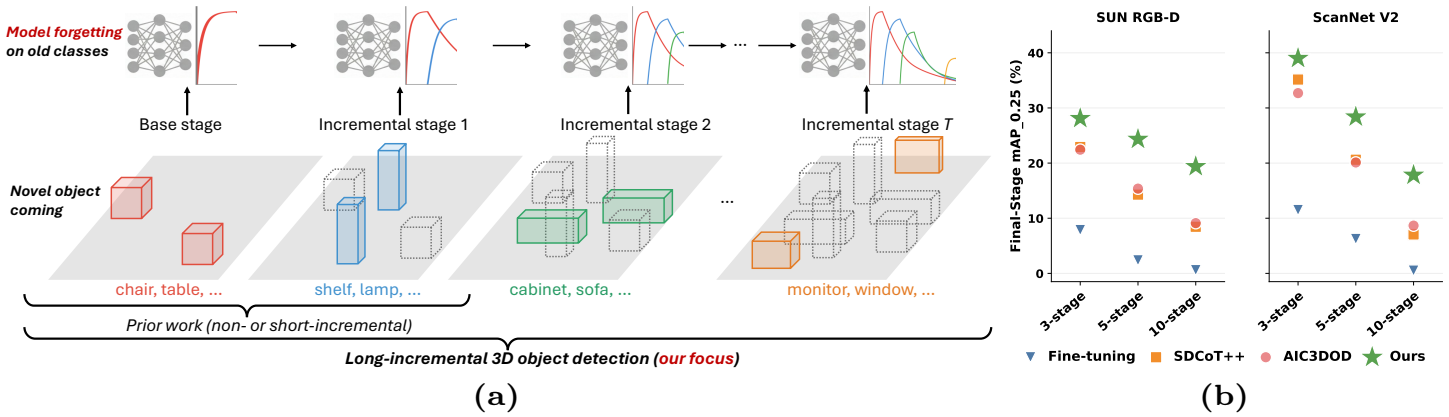
Incremental 3D object detection requires a detector to learn novel object classes while remembering previously learned ones over sequentially arriving data. Previous methods, primarily based on pseudo-labeling, perform reasonably in short-incremental stages but still suffer from severe model forgetting when dealing with long-incremental sequences. We investigate this failure and reveal a detrimental self-reinforcing cycle: data distribution shift of novel classes causes model forgetting on old classes, which further produces accumulated error in pseudo-labeling that exacerbates model degradation. To address this issue, we draw inspiration from the human learning process and propose the Learning-Dynamics-driven Memory and Review (LDMR) framework. LDMR monitors per-class detection quality at periodic training checkpoints and uses these learning-dynamics signals to drive two innovative mechanisms, namely (i) human-like intra-stage review that divides each incremental stage into multiple sub-stages' training and concentrates on remembering the most-forgotten objects, and (ii) scene-aware cross-stage memory evolution that evolves a memory bank to transfer knowledge between two consecutive stages by jointly considering scene learnability and diversity. Extensive experiments across multiple long-incremental protocols on indoor benchmarks SUN RGB-D and ScanNetV2 show that LDMR substantially mitigates the model forgetting and outperforms all baselines by a clear margin. Code is available at https://github.com/qianpeisheng/LDMR.
The forgetting cycle. In long-incremental 3D object detection, each stage introduces a new set of classes and the old classes are left unlabeled. Our analysis shows that the training distribution shifts substantially from stage to stage, and that this shift raises the empirical risk of the detector on old classes. Because pseudo-labeling methods supervise old classes with the predictions of the previous-stage model, a degraded model produces degraded pseudo-labels, which in turn degrade the next model. Distribution shift, model forgetting and pseudo-label error therefore form a self-reinforcing cycle that short-incremental protocols never expose.
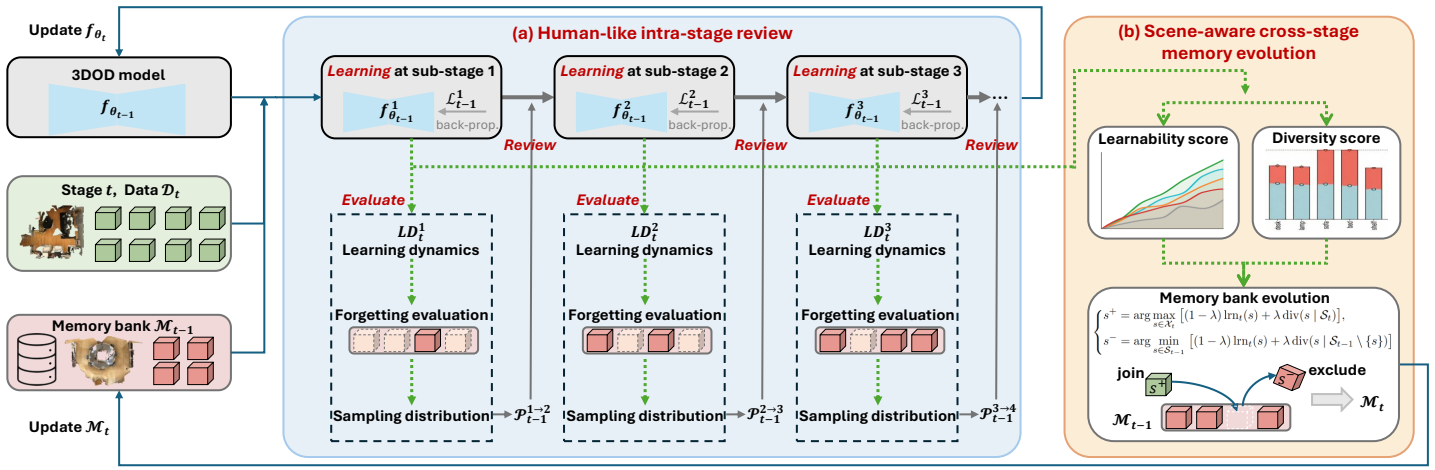
Human-like intra-stage review. LDMR splits each incremental stage into I sub-stages and, at each sub-stage checkpoint, evaluates the current model on the memory bank to record its learning dynamics: the per-class recall Rit(s, c) of every class in every memory scene. Comparing consecutive checkpoints gives a scene-level forgetting score Fs = Σc log(1 + ns,c) · max(0, Rit − Ri+1t), which weights each class by how many of its objects the scene contains. The sampling weight of a memory scene in the next sub-stage is then ws = 1 + η · Fs, so training time is redirected towards the objects the model is currently forgetting most, exactly as a student reviews the material they just failed.
Scene-aware cross-stage memory evolution. At the end of a stage, the same learning-dynamics signals decide which scenes are carried forward under a fixed memory budget. A scene's learnability aggregates, over its classes, a class under-learning weight ωt(c), the log object count log(1 + ns,c), and the learning gain Gt(s, c) observed across the sub-stage checkpoints. Its diversity is measured in a two-dimensional, L2-normalised learning-dynamics embedding et(s), so that the bank does not collapse onto scenes that behave alike. The two scores are combined as (1 − λ) · learnability + λ · diversity; the highest-scoring candidate enters the bank and the lowest-scoring resident leaves it. The bank thus keeps evolving into a compact set of scenes that is both informative and varied, and knowledge is transferred between consecutive stages without storing the full history.
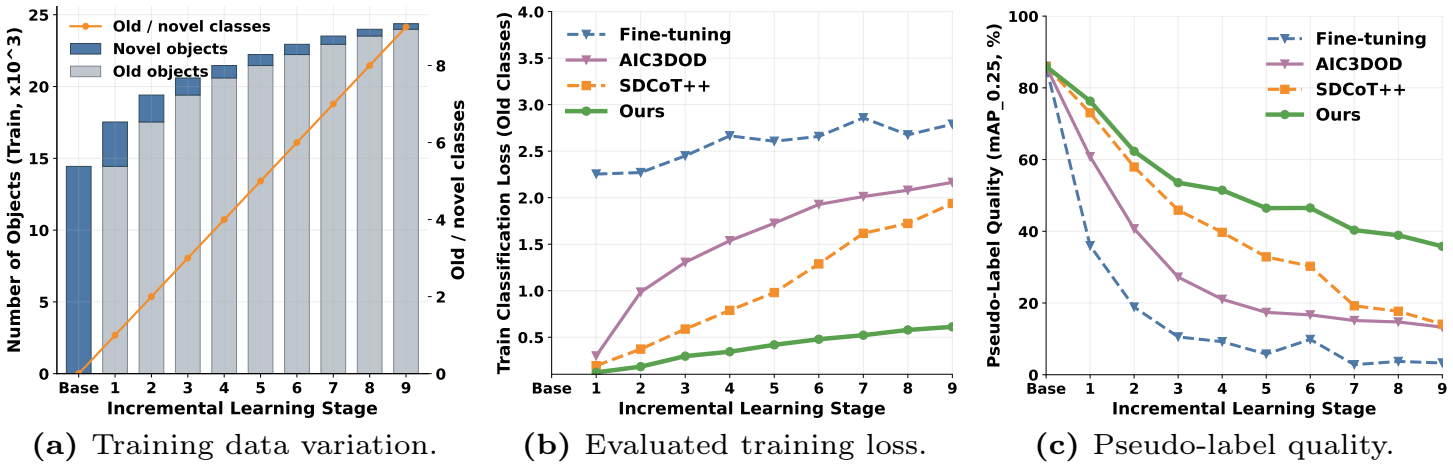
Table 1. Incremental 3D object detection performance (mAP@0.25) over 3-/5-/10-incremental stages on SUN RGB-D and ScanNetV2 benchmarks.
| Method | Backbone | SUN RGB-D (40 classes) | ScanNetV2 (35 classes) | ||||
|---|---|---|---|---|---|---|---|
| 3-stage | 5-stage | 10-stage | 3-stage | 5-stage | 10-stage | ||
| Fine-tuning | VoteNet [19] | 1.12 | 0.62 | 0.03 | 5.09 | 4.21 | 0.15 |
| CPDet3D [43] | VoteNet | 9.70 | 7.11 | 0.39 | 16.33 | 9.05 | 2.54 |
| AIC3DOD [4] | VoteNet | 10.73 | 7.32 | 0.85 | 19.21 | 15.51 | 1.60 |
| SDCoT [40] | VoteNet | 10.94 | 7.66 | 0.98 | 18.39 | 14.38 | 2.93 |
| SDCoT++ [41] | VoteNet | 11.39 | 7.86 | 1.67 | 18.51 | 16.19 | 3.38 |
| SDCoT++ & Random Memory | VoteNet | 11.52 | 7.93 | 3.53 | 21.19 | 19.46 | 7.25 |
| LDMR (ours) | VoteNet | 11.87 | 8.75 | 6.20 | 24.82 | 23.37 | 9.76 |
| Joint Training (Upper Bound) | VoteNet | 22.39 | 22.39 | 22.39 | 36.00 | 36.00 | 36.00 |
| Fine-tuning | TR3D [22] | 7.86 | 2.37 | 0.59 | 11.49 | 6.24 | 0.50 |
| CPDet3D [43] | TR3D | 8.71 | 7.55 | 3.32 | 18.76 | 7.26 | 0.66 |
| AIC3DOD [4] | TR3D | 22.43 | 15.37 | 9.11 | 32.69 | 20.11 | 8.66 |
| SDCoT [40] | TR3D | 22.10 | 13.77 | 8.72 | 34.65 | 20.86 | 6.93 |
| SDCoT++ [41] | TR3D | 22.92 | 14.28 | 8.45 | 35.15 | 20.61 | 7.06 |
| SDCoT++ & Random Memory | TR3D | 25.18 | 20.02 | 15.54 | 36.86 | 23.67 | 14.86 |
| LDMR (ours) | TR3D | 29.12 | 25.10 | 19.38 | 39.00 | 28.38 | 17.82 |
| Joint Training (Upper Bound) | TR3D | 33.26 | 33.26 | 33.26 | 51.52 | 51.52 | 51.52 |
Numbers are mAP@0.25 over all seen classes after the final stage. The gap to the previous best method widens as the sequence gets longer: with the TR3D backbone on SUN RGB-D, LDMR gains +3.94 / +5.08 / +3.84 mAP over SDCoT++ & Random Memory at 3 / 5 / 10 stages.
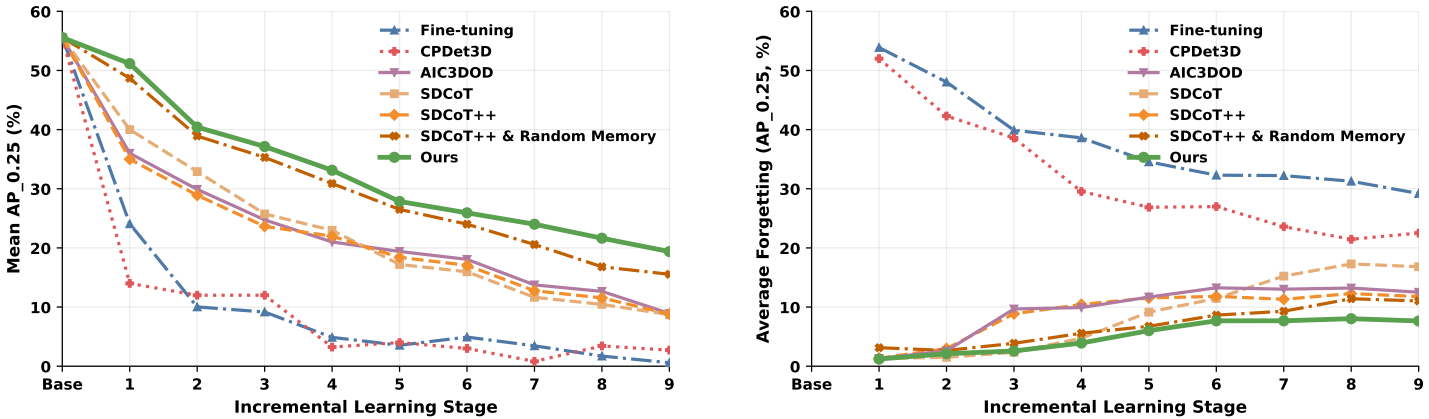
Table 2. Ablation study on our key modules of human-like intra-stage review (HR) and scene-aware cross-stage memory evolution (ME) (SUN RGB-D, TR3D, 3-/5-/10-stages' mAP@0.25).
| Method | 3-stage | 5-stage | 10-stage |
|---|---|---|---|
| LDMR (full) | 29.12 | 25.10 | 19.38 |
| w/o HR | 26.67 | 23.47 | 17.51 |
| w/o ME | 27.44 | 23.17 | 18.70 |
| w/o HR & ME | 25.18 | 20.02 | 15.54 |
Table 3. Comparison of alternative memory-bank schemes in SDCoT++ & Random Memory (SUN RGB-D, TR3D, 10-stage's mAP@0.25).
| Memory-bank scheme | mAP@0.25 |
|---|---|
| Random | 15.54 |
| Reservoir | 16.12 |
| Max #objects | 15.31 |
| Lowest recall | 14.10 |
| LDMR | 19.38 |
Table 4. Ablation on the scoring-function design choices (SUN RGB-D, TR3D, 10-stage mAP@0.25). Each variant alters one component of LDMR.
| Component | Design choice | mAP@0.25 |
|---|---|---|
| Count weight (Eqs. 4, 9) | linear: ns,c | 18.55 |
| sublinear: √ns,c | 19.01 | |
| log: log(1 + ns,c) (final design) | 19.38 | |
| Learnability (Eq. 9) | w/o ωt(c) (class under-learning weight) | 19.13 |
| w/o log(1 + ns,c) (object-count weight) | 17.86 | |
| w/o Gt(s, c) (learning gain) | 18.88 | |
| Under-learning weight | low-recall only | 18.45 |
@inproceedings{qian2026ldmr,
  title     = {Breaking the Model Forgetting Cycle in Long-Incremental 3D Object Detection},
  author    = {Qian, Peisheng and Xu, Jie and Yang, Xulei and Zhao, Na},
  booktitle = {Proceedings of the European Conference on Computer Vision (ECCV)},
  year      = {2026},
  publisher = {Springer},
  % TODO: add pages and DOI once the ECCV 2026 proceedings are published
  % pages  = {--},
  % doi    = {10.1007/---}
}
This research is supported by the Agency for Science, Technology and Research (A*STAR) under its MTC Programmatic Funds (Grant No. M23L7b0021), and the Ministry of Education, Singapore, under its MOE Academic Research Fund Tier 2 (MOE-T2EP20124-0013).